Table of Contents
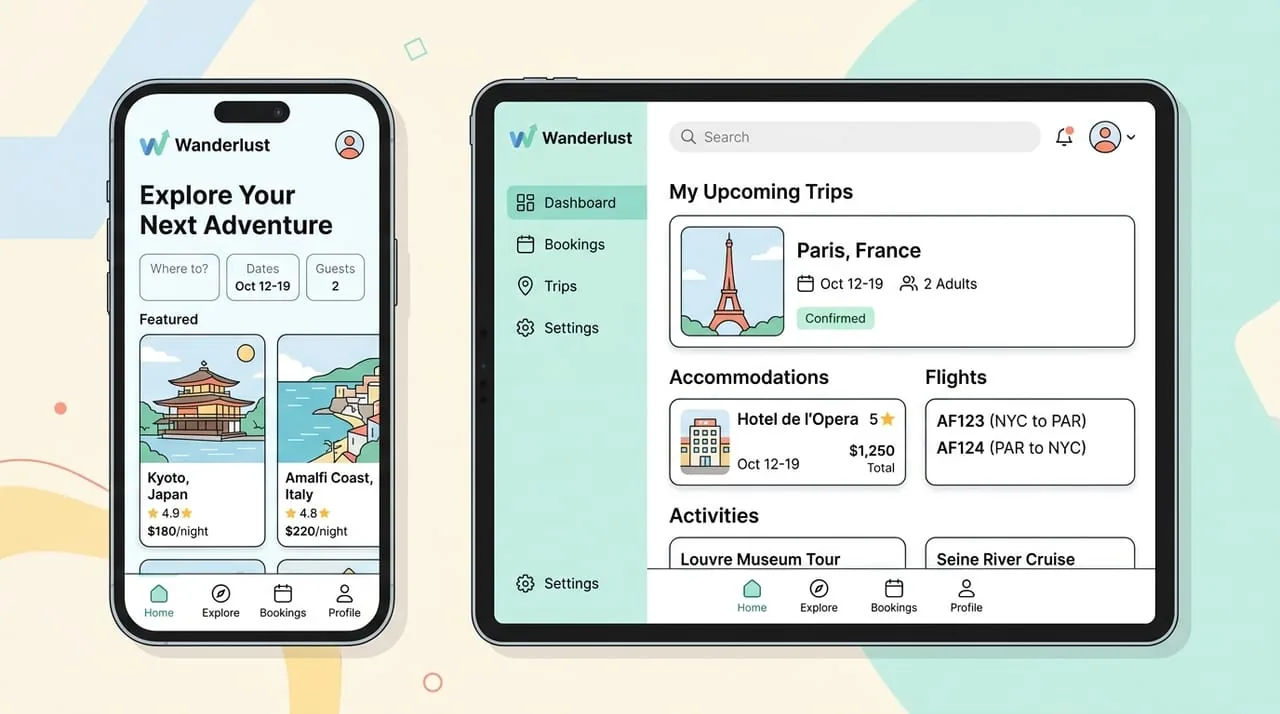
A modern web or mobile application is the primary channel for customer interaction and brand representation. To succeed in today's digital landscape, applications must be fast, highly responsive across all screen dimensions, visually engaging, and built on scalable backend architectures that secure user information.
Tech Stack Selection: Web & Mobile Frameworks
We select technologies based on performance, timeline, and maintenance requirements:
- Web Development (SPA / SSR): Utilizing React, Next.js, and TypeScript. Next.js allows us to implement Server-Side Rendering (SSR) for SEO-sensitive public pages, and Incremental Static Regeneration (ISR) for fast loading times.
- Mobile Development (Cross-Platform): We utilize Flutter and React Native to build high-performance iOS and Android apps from a shared codebase. This cuts development time and engineering costs nearly in half while maintaining close-to-native performance.
- Native iOS & Android Development: For apps requiring deep integration with device hardware, native camera SDKs, or background Bluetooth processes, we build native applications using Swift and Kotlin.
Responsive Design Systems & UI Excellence
A premium app requires a consistent design system:
- Responsive Layouts: Designing flexible grids and container queries that adjust smoothly from a 6-inch phone screen to a 30-inch desktop monitor.
- Component Libraries: Creating modular, reusable UI components (buttons, input fields, modal dialogs) using CSS variables or Tailwind CSS config to ensure visual coherence.
- Micro-Animations: Adding subtle transitions, hover states, and scroll animations (using libraries like Framer Motion) to make the experience feel reactive and alive.
API Integration, State Management, and Offline Syncing
Connecting the frontend to data services requires clean architecture:
- State Management: Utilizing lightweight tools like Zustand or Context API for smaller applications, and Redux Toolkit for complex, enterprise-grade state flows.
- Offline Storage & Syncing: Implementing local caching (using IndexedDB or SQLite) so the app remains usable on weak network connections, with automatic optimistic UI updates that synchronize with the server once connectivity is restored.
Performance Optimization & Core Web Vitals
Slow apps lose customers. We optimize apps by:
- Code Splitting & Lazy Loading: Loading only the JavaScript required for the active route, decreasing initial bundle sizes.
- Image Optimization: Serving compressed WebP images with responsive sizes and lazy loading tags.
- SEO Configurations: Adding proper titles, meta tags, Open Graph cards, and structured semantic HTML to ensure search engines index your pages correctly.
JTech's Application Development Process
At JTech Solution, we turn ideas into functional, production-grade applications. We design custom UI layouts, write clean frontend interfaces, build secure REST/GraphQL API backends, connect database services, and deploy applications on reliable cloud systems. We build software that performs well and supports your business growth.
Tags

Madiha Javaid
Content Writer at JTech Solution
A senior technology expert at JTech Solution with deep expertise in building and scaling digital products. Passionate about writing clear, practical content for engineering teams.